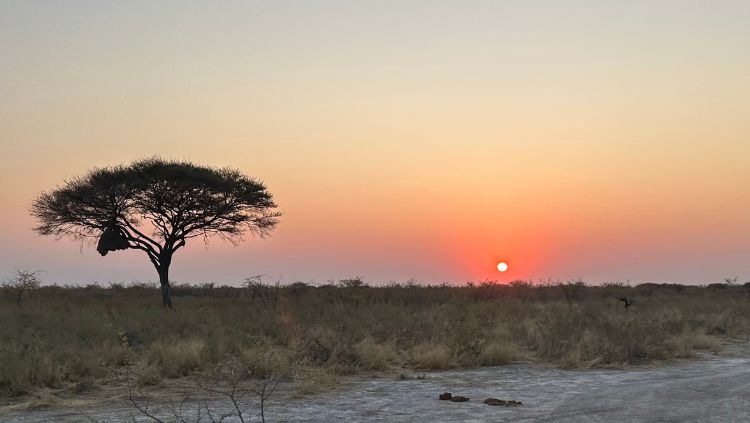
Coming from Canada where a small population lives in a large land mass, I've never been surprised by the scale of a country and its landscape before. Then came travel to Namibia. I had difficulty getting a handle on it. Every experience in Namibia was on a larger scale than expected.
Without context, it's difficult to get a sense of the size of something.
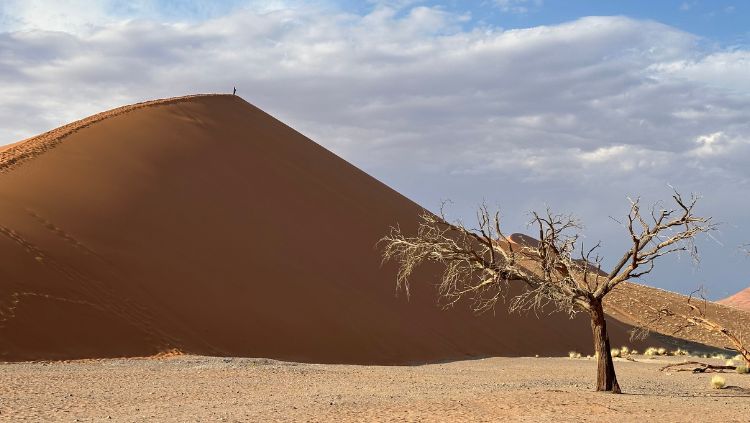
With only other dunes for context there was no context for me. I'm sure a Namibian has an understanding of a dune's size but I didn't. Walking up the crest of Dune 45 I was shocked to look back and see how small the people and cars were below, giving me a sense of just how high I was. Looking from the ground up, it didn't seem that big.
Look at the photo above. Many people miss the fact that there is a person at the peak of the dune. How often does one see a person that far away? It's rare. It's not part of my daily experience whether I'm traveling or at home.
Namibia defied my internal sense of scale again and again. It was exhilarating.
Thank you to Exodus Adventure Travels for their support on this trip. Please be assured that all I have to say is based on my personal experience.

The Namib Desert of Dunes and Mummified Trees
The dunes of the Namib Desert (the desert stretches from Angola to South Africa) are said to be the oldest in the world. When I heard that, I wondered, what does that even mean?
The dunes are part of the UNESCO World Heritage Site called the Namib Sand Sea coastal desert. There are actually two dune systems within each dune. There's the ancient semi-consolidated dune overlain by a younger active dune. The desert has been arid or semi-arid for between 55 and 80 million years. By contrast, my reading suggests that the Sahara has only been a desert for perhaps 2 million years.
The scale of the dunes in both size and time was intriguing.
Not far from Dune 45 are the clay pans of Deadvlei and Sossusvlei. The clay pans sit surrounded by dunes holding mummified acacia trees. The area is so dry that it prevents the normal decay process and makes the trees resistant to decomposition. They are estimated to be 900 years old.
Again, look at the photo above to get a sense of the size of these pans by looking at the people in the bottom right corner.
Washboard Roads and the Kuiseb Pass
Shane, our local guide and driver, referred to them as “good African roads that offer a free massage”.
The experience lived up to his words.
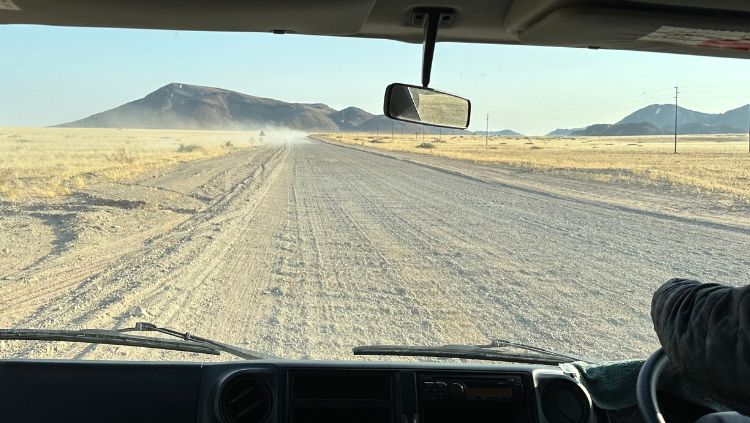
There are paved roads in the towns and major routes of Namibia but most of the roads we were on that took us into the more interesting parts of Namibia were gravel. Gravel and sand with potholes and the rippled patterns of a washboard or corrugated metal.
The antics to navigate these roads, Shane searching for the smoothest routes, were entertaining. The vibration was continual. At one point, the bouncing was so great that I took a video. Now, if you had back or hip problems, this feature of Namibia travel could be good, or bad, for them. Amongst our group, there was no complaining and often great amusement.
Leaving Deadvlei we drove to Swakopmund with a stop for lunch at Walvis Bay. On the drive we crossed the Tropic of Capricorn. What I didn't know is that this imaginary line marks the southernmost latitude where the sun can appear directly overhead at noon.
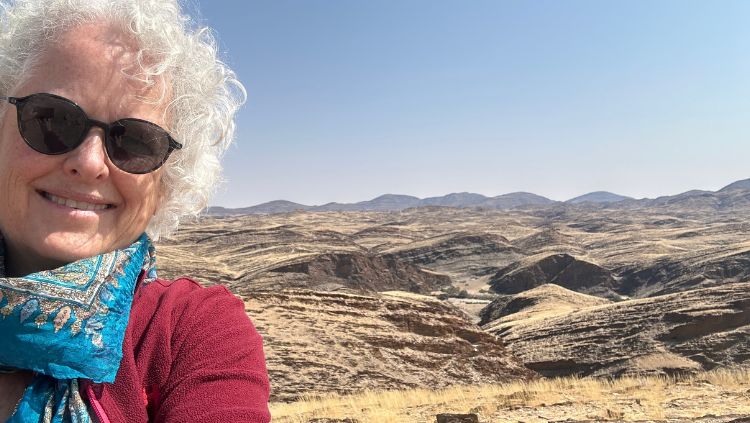
En route, we went through the Kuiseb Pass which includes a river (dry when we were there) and canyon. The landscape is as you can see in the photo above. The canyon is dramatic and famous for being the home of two German geologists who hid there during World War II to avoid internment. The story is told in the book The Sheltering Desert.
I will be writing a full post on Swakopmund in another week or so.


Hike to White Lady Rock
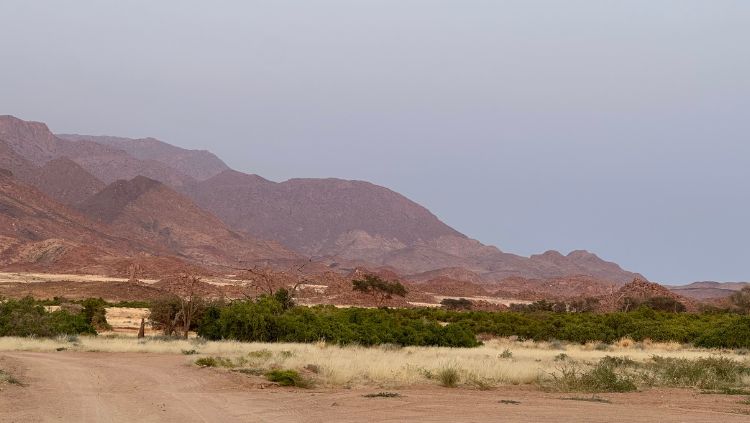
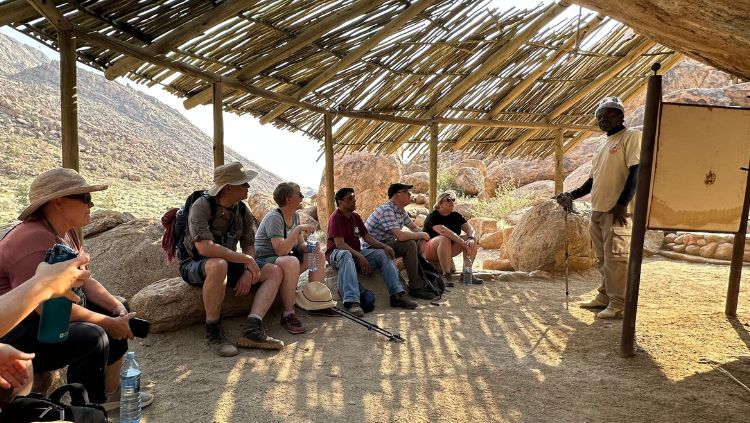
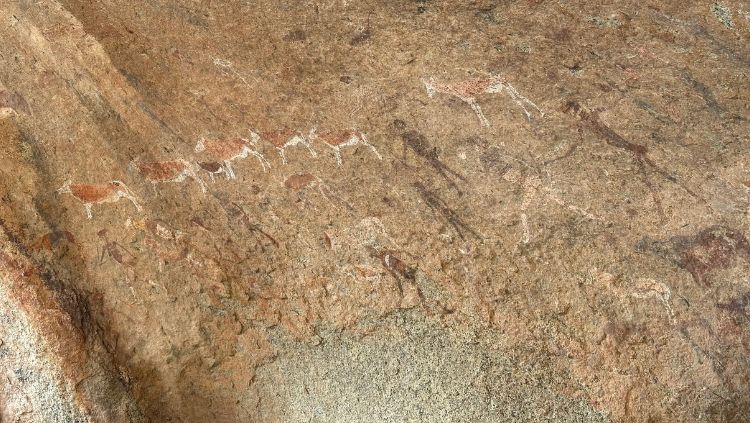
The hike through Valley 45 of Brandberg Mountain took us to the White Lady rock painting which, along with over 1,000 other small paintings and engravings, are thought to have been left by San hunter-gatherers at least 2,000 years ago.
The name “White Lady” is a misnomer. The central character was assumed to be a lady and white because the legs are white. However, the person is actually a shaman who, in a ritual dance, works up a sweat and the dust around him causes his legs to be white. As is typical of such an interpretation, it was made by a westerner.
The hike required attention to the path that was sometimes more rocks than a path. It's about 2 km long and, while not difficult, it required some stability and strength. One person chose not to do it.
Covering Namibia Travel
Essentially, I've broken my reporting on my Namibia travels into 5 parts. In addition to this post, so far you have:
- Exploring Namibia on a Small Group Tour
- Planning Travel to Namibia: How to Get the Details Right (which I have updated since returning)
Posts coming up soon:
- Faces of Namibia: Meeting Its People, Culture, and Complex Past
- Namibia’s Wild Side: Safaris, Night Drives, and Unexpected Sightings